|
|
|
|
WORLD MALARIA REPORT 2025
Addressing the threat of antimalarial drug resistance
Geneva, World Health Organization, 2025, 212 pages
|
https://www.who.int/publications/i/item/9789240117822
|
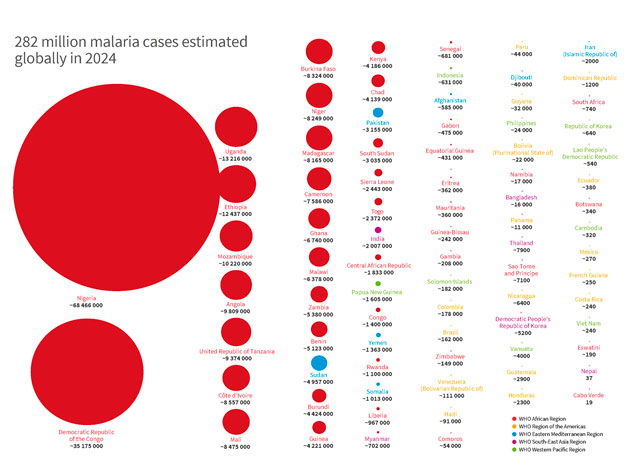
Оценочное количество случаев малярии в каждой
стране и регионе в 2024 году (стр. 7)
В 2024 году в мире от малярии умерло около 610000
человек (Таблица 2.1), что на 12000 больше, чем в 2023 году.
На три страны - Мадагаскар (+4900), Эфиопию (+3800) и Йемен
(+932) - приходится 85% увеличения числа смертей от малярии
с 2023 по 2024 год. В период с 2000 по 2015 год число смертей
от малярии снизилось на 33,1% - с 864000 до 578000. В период
с 2015 по 2024 год число смертей увеличилось на 5,5%, причем
более трети этого увеличения приходится на период с 2023 по
2024 год. В 2024 году четыре страны - Нигерия (30,3%), Демократическая
Республика Конго (11,1%), Нигер (5,8%) и Объединенная Республика
Танзания (4,3%) оказались в числе лидеров по этому показателю
- на их долю приходится чуть более половины всех смертей от
малярии в мире (рис. 2.3d). На Нигерию приходится 38,6% всех
смертей от малярии среди детей в возрасте до 5 лет в мире.
Страницы 10-11
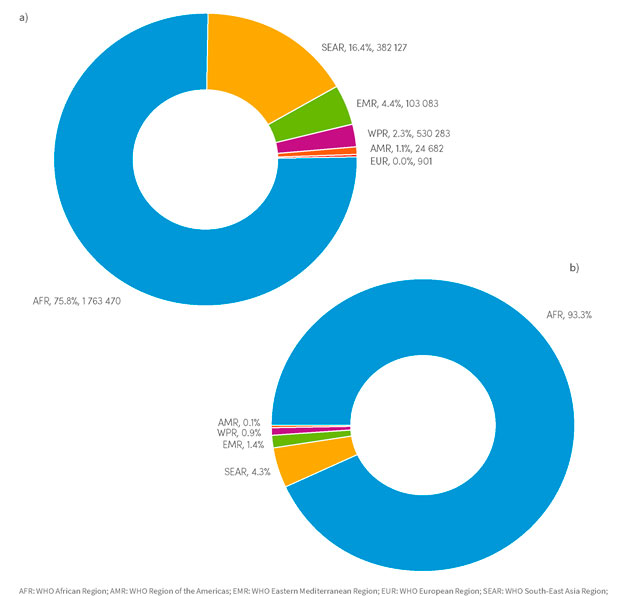
Процент а) абсолютного числа лучаев малярии (в
тысячах) и б) предотвращенных смертей от малярии по регионам
ВОЗ, 2000-2024 гг. (стр. 41)
|
Ежегодный Всемирный доклад о малярии служит важным инструментом
для оценки глобального прогресса и выявления пробелов в борьбе с
малярией. В этом году доклад представляет собой критически важный
и актуальный обзор усилий по борьбе с малярией и ее искоренению
в 80 странах, включая эпидемиологическую ситуацию, прогресс в реализации
глобальной технической стратегии, ситуацию с финансированием, состояние
мероприятий по борьбе с малярией и возникающие биологические угрозы.
В докладе, также, в отдельной главе рассматривается
угроза, создаваемая устойчивостью к противомалярийным препаратам,
и ее влияние, подчеркивая необходимость более скоординированного
и эффективного реагирования, адаптированного к местным условиям
и поддерживаемого регулированием, надежными системами обеспечения
качества, активным участием медицинских работников, а также своевременным
сбором и обменом высококачественными данными о лекарственной устойчивости.
Contents
Foreword
Acknowledgements
Abbreviations and acronyms
1. Introduction 1
1.1 WHO/MNT priority initiatives
1.2 New and updated guidance
2. Global trends in the burden of malaria and progress
towards GTS milestones
2.1 Global estimates of malaria cases and deaths, 2000-2024
2.2 Global progress towards GTS milestones
2.3 Estimated malaria cases and deaths in the WHO African Region,
2000-2024
2.4 Estimated malaria cases and deaths in the WHO Region of the
Americas, 2000-2024
2.5 Estimated malaria cases and deaths in the WHO Eastern Mediterranean
Region, 2000-2024
2.6 Estimated malaria cases and deaths in the WHO European Region,
2000-2024
2.7 Estimated malaria cases and deaths in the WHO South-East Asia
Region, 2000-2024
2.8 Estimated malaria cases and deaths in the WHO Western Pacific
Region, 2000-2024
2.9 Malaria burden in HBHI countries
2.10 Cases and deaths averted since 2000, globally and by WHO
region
2.11 Country-reported malaria cases disaggregated by sex
3. Elimination and prevention of re-establishment
3.1 Progress to elimination
3.2 Malaria elimination and certification
3.3 P. knowlesi disease burden and transmission
3.4 Preventing re-establishment and maintaining malaria free status
4. Investments in malaria programmes and research
4.1 Funding trends for malaria control and elimination
4.2 Investments in malaria-related R&D
5. Distribution and coverage of malaria prevention,
diagnosis and treatment
5.1 Distribution and coverage of ITNs
5.2 Population protected with IRS
5.3 Seasonal malaria chemoprevention (SMC)
5.4 Perennial malaria chemoprevention (PMC)
5.5 Malaria in pregnancy
5.6 Malaria diagnosis and treatment
5.7 Malaria vaccine for the prevention of P. falciparum malaria
in children
6. Biological threats to malaria interventions
6.1 Detection of pfhrp2/3 gene deletions
6.2 Antimalarial drug efficacy (2015-2025)
6.3 Insecticide resistance
6.4 Invasive species
7. Antimalarial drug resistance: progress and challenges
ahead
7.1 Introduction
7.2 Monitoring antimalarial drug efficacy and resistance
7.3 From conditions to care: how systems shape resistance
7.4 Responding to resistance: lessons and the path forward
7.5 Final outlook
8. Conclusion
8.1 Trends in malaria burden
8.2 State of malaria interventions
8.3 Risks to progress
8.4 Opportunities and the path forward
References
Annexes
Annex 1 - Data sources and methods
Annex 2 - Number of ITNs distributed through campaigns in malaria
endemic countries, 2022-2024
Annex 3 - A. WHO African Region, c. Countries with high transmission
in east and southern Africa
Annex 3 - A. WHO African Region, d. Countries with low transmission
in east and southern Africa
Annex 3 - B. WHO Region of the Americas
Annex 3 - C. WHO Eastern Mediterranean Region
Annex 3 - D. WHO South-East Asia Region
Annex 3 - E. WHO Western Pacific Region
Annex 4 - A. Policy adoption, 2024
Annex 4 - B. Antimalarial drug policy in malaria endemic countries
and areas, 2024
Annex 4 - C. Household survey results, 2017-2024, a. Compiled
through STATcompiler for the WHO African Region
Annex 4 - D. Malaria endemic countries and areas
Annex 4 - E. Countries and areas certified malaria free by WHO
(1955-2025) and countries where malaria never existed or disappeared
without specific measures
|



